Webinars
Run pre-recorded video as a live-feeling webinar, or broadcast live via YouTube Live: scheduling, chat, timed offers and replay.
There are two kinds of webinar here: automated (a pre-recorded video played as if live) and live (you actually broadcast via YouTube Live). Both share the same registration, reminders, chat, interaction cards and replay.
An automated webinar runs a pre-recorded video as if it were live: attendees register, arrive at their session time, and watch what feels like a broadcast. Under the hood it's the same video, positioned to the second based on each person's session start.
You record once and can run sessions every day — without actually sitting in front of a camera every week.
You can also run a live broadcast: same registration, chat and replay, with the video coming from a real YouTube Live stream. See the “Live broadcasts” section at the end of this page.
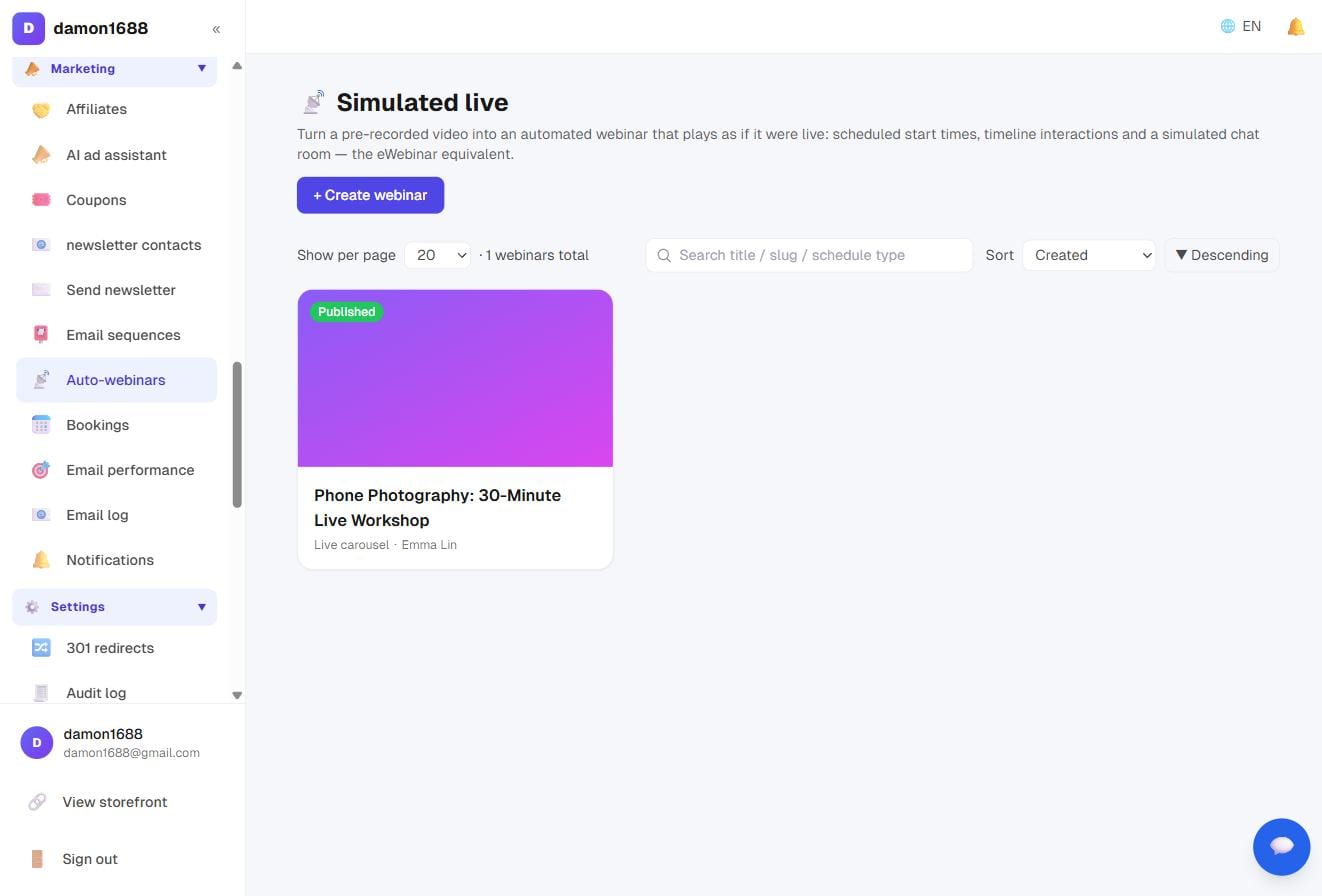
Marketing → Automated webinars → New.
Three scheduling modes
| Mode | Behaviour | Best for |
|---|---|---|
| Just-in-time | A new session every N minutes (5/10/15/30/60) | Maximum urgency — register and it starts in minutes |
| Fixed times | Specific weekly or daily slots you choose | Making it feel like a real scheduled event |
| On demand | Starts seconds after registering | Lowest friction, but no anticipation from waiting |
Video and the timeline
- Paste a YouTube or Vimeo URL, or upload straight to Bunny
- You must enter the video length manually: it's the reference for the whole timeline. Get it wrong and every interaction card and chat message fires at the wrong moment
People who arrive late are dropped in at the point the session has reached, and can't fast-forward during the broadcast — just like a real one.
Scripted chat
The Simulated chat tab lets you schedule messages in advance: at what second, from whom, saying what, and optionally flagged as the host (shown with a gold crown).
When playback reaches that second the message appears in the chat, mixed into the same timeline as real attendees' messages.
You can also reply to real questions live from the host console.
Timeline interactions
The Interaction timeline tab pops things up at a chosen second:
- CTA button
- Limited-time offer (with an optional countdown)
- Poll
- Text prompt
- Handout download
Each card has its own display duration and disappears automatically.
Room settings
- Viewer count: set a range and the on-screen number drifts naturally within it
- Show chat / show viewer count: each can be turned off
- Accent colour and registration page copy
Registration and reminders
The registration page lives at /w/{slug}. Registrants automatically join your list with a webinar tag.
Four reminder emails can each be switched on or off: 1 hour before, 10 minutes before, at start time, and missed (with the replay link).
Replay
You can enable replay and set how many hours it stays open, counted from the end of that person's own session. After that the replay link stops working.
Reporting
Each webinar shows registrations, attendance, attendance rate and average watch time — which is how you find where the content loses people.
Live broadcasts (YouTube Live)
Everything above is pre-recorded. If you want to actually go live — you in front of the camera, people watching on your own site, you answering their chat as it happens — switch “Broadcast type” to Live broadcast. Registration, reminders, chat, interaction cards, replay and attendance all work exactly the same; only the source of the video and the moment it starts are different.
The stream runs on YouTube Live, but viewers never see YouTube. They watch in your own webinar room, which requires registration — so the list, the offers and the replay all stay with you.
Four steps
1. Create the webinar and pick the type Under Marketing → Automated webinars → New, choose Live broadcast (YouTube Live) at the top of “Basics & video”.
2. Create the stream on YouTube and paste its URL Create the broadcast on YouTube, set it to Unlisted (not Private — nobody else can watch a private stream), and paste the URL into “YouTube Live URL”. All three formats work:
https://www.youtube.com/live/xxxxxxxxxxx(what you get from the live page)https://youtu.be/xxxxxxxxxxxhttps://www.youtube.com/watch?v=xxxxxxxxxxx
A plain talking-head stream can be started from YouTube itself with your webcam. For slides plus a camera inset — how most webinars look — you need free software such as OBS.
3. Schedule the session Under “Schedule”, pick Specific date and set the date and time, e.g. 20 Sep 20:00. A live broadcast is usually a one-off; add more rows for a series.
Fill in “Planned length” — it only drives the replay window and what the signup page shows. It does not end the broadcast.
4. Publish and share the signup page
Hit Publish; the signup page is your-domain/w/your-slug.
On the day
- Start streaming on YouTube (or OBS) first and confirm the picture is up
- Open the 🎙️ Host console for that webinar
- Press ● Go live
The moment you do, everyone waiting in the room switches to the stream — no need to ask them to refresh.
⚠️ Don't reverse the order: press Go live before YouTube is actually streaming and your viewers stare at a spinner.
During the broadcast, from the host console you can:
- Read and answer chat — your replies are marked as host and appear instantly for everyone
- Push interaction cards — when you reach your offer, hit “Push to viewers” and the card appears on every screen. Pushed the wrong one? “Retract”.
When you're done, press ■ End broadcast and viewers move to the ended screen.
After the broadcast: replay
For live broadcasts you supply the replay yourself: YouTube keeps an archive of the stream, so paste that URL into “Recording for replay” and people who missed it can watch during the replay window. Leave it blank and the ended screen simply says there is no replay — rather than offering a button that does nothing.
Live vs automated
| Automated | Live | |
|---|---|---|
| When it starts | Automatically at session time | You press “Go live” in the host console |
| Interaction cards | Fire on the timeline (at N seconds) | Pushed by you, when you get there |
| Chat | Scripted + real messages | Real messages only |
| Viewer count | Your simulated range | The real number |
| Latecomers | Dropped in at “where it should be” | Start from now, like any live stream |
| Replay | The same pre-recorded video | The archive you paste in afterwards |
FAQ
Are viewers a few seconds behind? Yes, roughly 10–30 seconds — true of every YouTube/HLS broadcast, WebinarJam included. So chat lags: someone may be asking about what you said a minute ago. Nothing is broken; just expect it.
Will people wander off to YouTube? The room uses an embedded player with no related-video sidebar. An unlisted stream doesn't appear in search or on your channel unless someone passes the link around.
Can viewers come on stage with me? Not currently. This is one-to-many broadcasting, not a Zoom-style meeting.
The scheduled time passed and nothing appeared. Live broadcasts never start by themselves — you press “Go live”. That is deliberate: dropping people into a room before your gear is ready is worse than starting a few minutes late.
I forgot to press End. Viewers stay on the stream. Once you stop streaming, the player shows that the broadcast ended — but the ended screen and replay only appear after you press “End broadcast”.
FAQ
Is this misleading to attendees? Neither the registration page nor the room claims to be broadcasting live. Most platforms neither stress it nor deny it. If it bothers you, say plainly on the registration page that it's a recorded session — in practice the effect on conversion is usually smaller than people expect.
Can attendees post messages? Yes. Real messages appear immediately, and you can answer them from the host console.
What if I enter the wrong video length? Interaction cards and scripted chat are all triggered by seconds, so the wrong length makes them fire at the wrong time, or ends the session early. After changing it, walk through the timeline again.
Reminders aren't arriving. Reminder emails need your own email provider (Settings → Email). Also check whether that particular reminder has been switched off.