
Get quoted by Google and AI (AEO)
Why the excerpt, SEO description and FAQ matter, and exactly how to write each one — with good and bad examples.
More and more people get answers without clicking a link: they read Google's featured snippet at the top of the results, ask ChatGPT or Perplexity, or ask a voice assistant. These tools pick content that answers a question in one paragraph and quote it with a source link.
AEO (Answer Engine Optimization) means writing your posts so they are easy to pick. When you get quoted, your site's name appears next to the answer — readers who want more click through, and they tend to be more ready to buy than ordinary search visitors.
The technical side is already handled: every post outputs structured data (title, dates, author, FAQ), and your site publishes a directory for AI tools. What only you can do is how the content is written — that's what this page covers.
Improve a post with the checklist, step by step
Step 1: Open a post and find "Get your post quoted by Google and AI"
In the left menu, click "Website → News / Blog" and click "Edit" on a post. Scroll down the right column to "SEO settings" — the checklist sits at the top, with a "n/6 done" count.
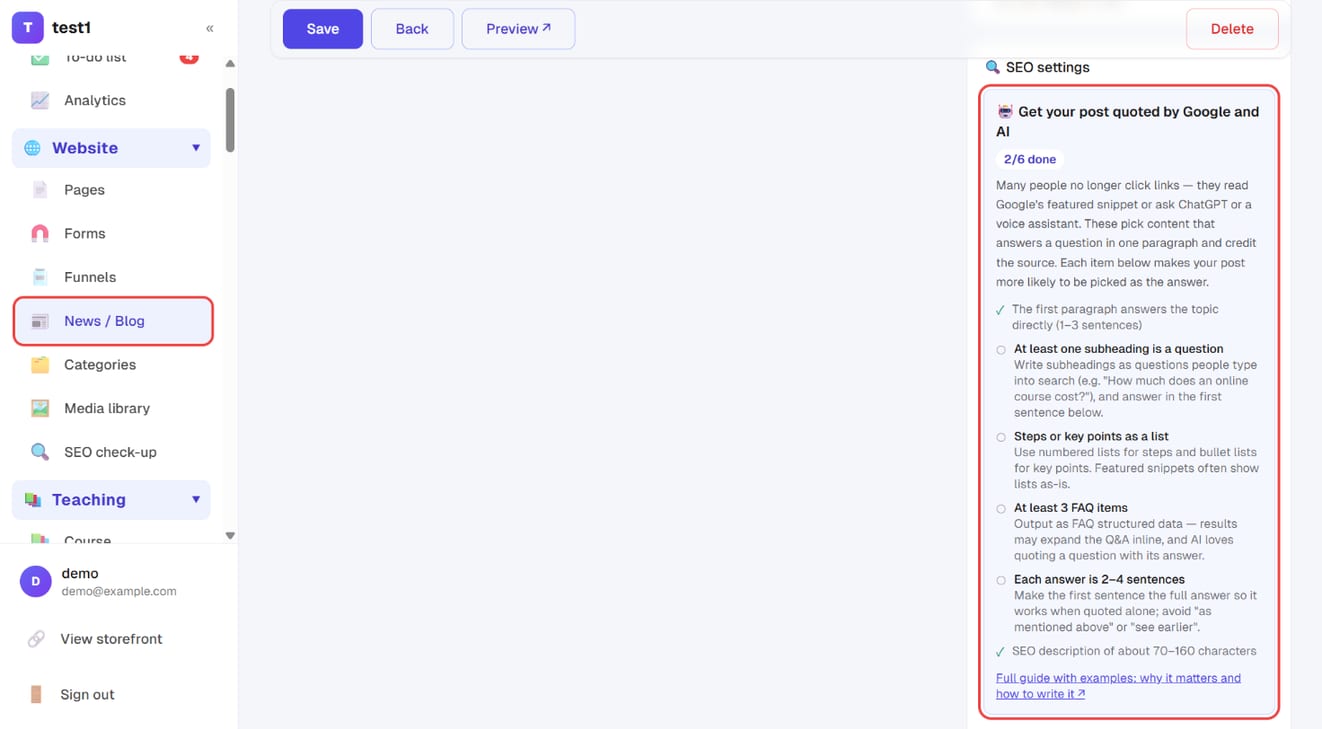
Step 2: Tick items off as you write
Work through the table below. Each item ticks itself as soon as the post meets it; the "Full guide with examples" link at the bottom brings you back to this page.
| Item | Why it matters |
|---|---|
| The first paragraph answers the topic directly | Search engines and AI quote the opening paragraph most often |
| At least one subheading is a question | A question subheading plus the answer below it is a ready-made Q&A |
| Steps or key points as a list | Featured snippets often show lists as-is |
| At least 3 FAQ items | Output as FAQ structured data; results may expand them inline |
| Each answer is 2–4 sentences | Too short doesn't answer; too long won't be quoted whole |
| SEO description of about 70–160 characters | The grey text under the result title, and a signal of what the post is about |
It's a guide, not a gate — you can publish without every tick.
First paragraph: lead with the answer
Readers (and AI) decide from the opening whether to keep going. Answer the post's core question in the first paragraph, in one to three sentences.
- ❌ "In this post, we'll share some tips about organizing your closet that we hope you'll find helpful."
- ✅ "Organizing a closet takes three steps: empty and sort everything, place items by how often you use them, and switch to matching hangers. Most closets take one afternoon."
Subheadings: write the questions people search
Turn a few subheadings into questions readers would type into a search box, and make the first sentence under each one the answer.
- ❌ "Storage tools"
- ✅ "Do you need to buy storage boxes first?" → first line below: "No — sort and measure first, then buy, so you don't buy the wrong size."
Use numbered lists for steps and bullet lists for key points. When you mention prices, time or quantities, give real numbers instead of "affordable" or "quick".
Excerpt
Shown in the post list and social share previews, and used as the search description when the SEO description is empty. State the post's conclusion in one or two sentences — don't just rephrase the title.
SEO description (meta description)
The grey text under the title in search results. Formula: what the reader gets + one concrete detail (a number, a step count, who it's for), about 70–160 characters.
- ❌ "This post is about closet organization." (vague — no reason to click)
- ✅ "Clear out your closet in 3 steps, with a free checklist and the 5 most common mistakes. Beginners can finish in one afternoon."
If it's empty the excerpt is used; if both are empty, search engines grab text from the page themselves — often something irrelevant.
FAQ
The Q&A at the end of the post, also output as FAQ structured data. This is the part most likely to be quoted by AI and featured snippets.
Choosing questions
- Write 3–5 questions readers would still have after reading the post
- Use full questions, the way people type them: "What size storage boxes should I buy?" — not "Sizes"
- Don't repeat your subheadings
Writing answers
- 2–4 sentences
- The first sentence is the complete answer, so it still makes sense when quoted on its own
- Avoid "as mentioned above", "see earlier" or "this" — the quote won't include the rest of the post
Example:
Q: What size storage boxes should I buy? A: Measure the inside of the drawer or shelf and choose boxes 1–2 cm smaller. Widths that combine well, like 15 cm and 30 cm, waste the least space when you add or remove boxes later.
AI writing follows these rules automatically
Posts created with AI writing already open with a direct answer, phrase at least half the subheadings as questions, and include 3–5 FAQ items and an SEO description. Afterwards, read it through and add your own experience and numbers — both AI and search engines favour first-hand content.
If your own AI tool writes posts through the AI connection, the tool instructions it receives include the same rules.
Common questions
Q: Is a post penalised if it has no FAQ? No — it just misses one chance to be quoted. The post still appears in search results.
Q: Does AEO conflict with SEO? No. Leading with the answer, clear structure and question subheadings are simply good writing, and help normal rankings too.
Q: How soon will I see results? Search engines usually re-read a post within days to a few weeks. Watch impressions in the Google Search Console "Performance" report.