Email Delivery Setup
Connect your own email provider, and why notifications and bulk email use two separate connections.
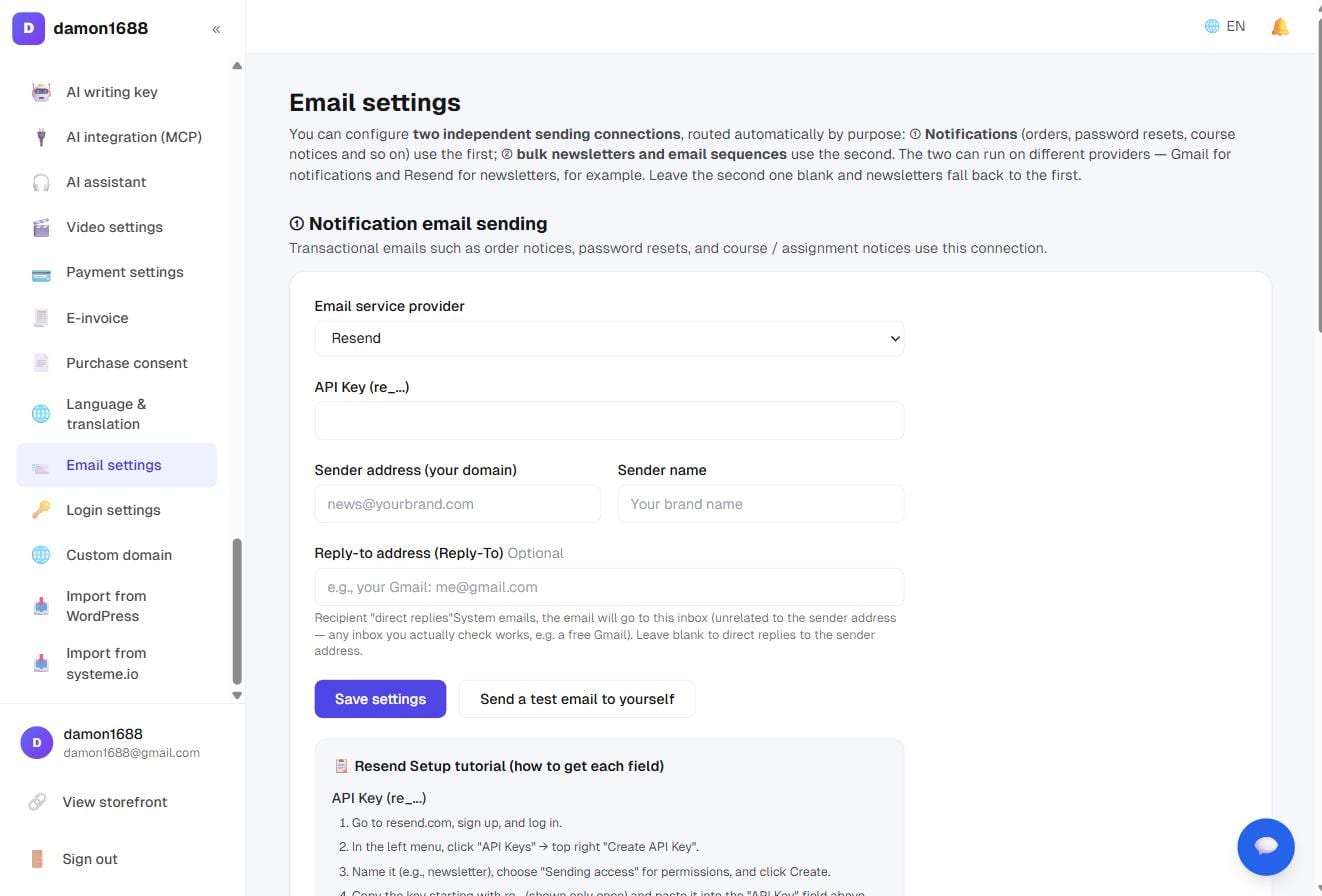
Settings → Email. This is probably the most-skipped setting on the platform, and the one that causes the most trouble.
First: what the platform sends for you
| Type of email | Before you set this up |
|---|---|
| System notifications (password resets, registration confirmations, order notices) | Sent by the platform — works out of the box |
| Newsletters and sequences | Not sent at all |
Bulk email has to go out on your own domain and sending reputation. That isn't an arbitrary restriction: one marketing email that gets reported drags down deliverability for everyone sharing a sender, so the platform doesn't send that category on your behalf.
Two separate connections
This page holds two connections, routed automatically by purpose:
- Notifications: transactional mail — orders, password resets, course and assignment notices
- Bulk newsletters and sequences: broadcasts
Leave the second one empty and it falls back to the first. Splitting them lets you use a different provider for each — Gmail for notifications (low volume, easy setup), Resend for newsletters (bulk sending, statistics).
The more practical reason is protecting your transactional mail: if a campaign ever gets a wave of spam complaints and that sender's reputation drops, your password-reset emails don't go down with it.
Supported providers
Resend / SendGrid / Mailgun / Amazon SES / Gmail
With no strong preference, Resend is usually the least work: clean interface, a clear domain-verification flow, and a free tier that covers a site that's just starting out.
The settings page expands step-by-step instructions for whichever provider you pick — what to fill in and where to get the key — so it isn't repeated here.
The step you must not skip: verify your sending domain
Whichever provider you choose, verify your sending domain in their dashboard (adding the SPF / DKIM records they give you to your DNS).
Skipping this doesn't mean "email fails to send". It means email sends and lands in spam — the hardest kind of failure to notice, because your dashboard says delivered.
⚠️ A specific gotcha with Amazon SES: new accounts start in sandbox mode and can only send to addresses you've already verified. You have to request production access from AWS before real use.
Test before you rely on it
The settings page has a send test button that emails you for real. Confirm you received it before sending a newsletter — don't use your actual list as the test.
Every email sent is recorded under Marketing → Email log, including failure reasons. Start troubleshooting there.
FAQ
My emails land in spam. Nine times out of ten, domain verification is incomplete. Go back to your provider and check the domain shows as Verified.
Can I send newsletters through my own Gmail? Technically yes, but don't: Gmail has daily sending limits, and a personal account flagged for bulk sending is a risk you don't want. Move to a dedicated sending service once your list is more than a few hundred people.
Do unsubscribed people still receive mail? No. Unsubscribes and hard bounces are excluded from every future send automatically — you don't maintain a suppression list.
What if I leave both empty? Notifications still work (the platform sends them). Newsletters and sequences won't send at all.