
Marketing and enrolment · 2026-10-09
A $3.5 Million Violin Made $32 in a Subway Station
1,097 people walked past one of the world's best violinists. Seven stopped. What that experiment says about your website, your copy and your buy button.
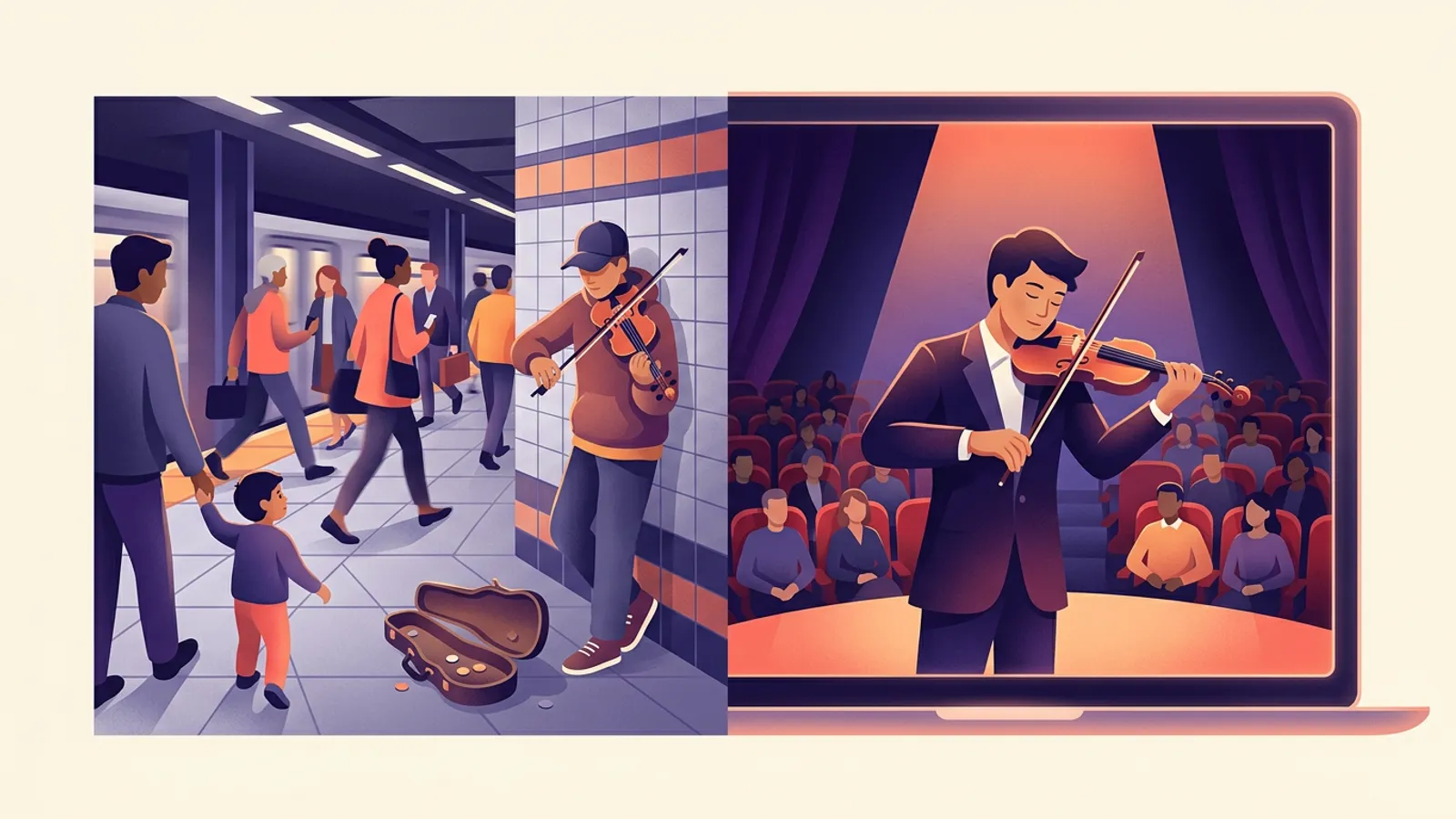
January 12, 2007. 7:51 a.m.
L'Enfant Plaza, a Metro station in Washington, D.C., at the height of the morning rush.
A young man in a baseball cap stands by a wall, opens a violin case, tosses in a few dollars as seed money, and starts to play.
He plays for 43 minutes. Six classical pieces.
In that time, 1,097 people walk past him.
Seven stop to listen for more than a minute.
When he's done, the case holds $32.17.
Sounds like any other busker, right?
Except he wasn't.
▋Who he was
His name is Joshua Bell. One of the finest violinists alive, with a Grammy to his name.
The instrument in his hands was a 1713 Stradivarius, worth about $3.5 million.
Three days earlier, he'd played to a full house at Boston's Symphony Hall, where pretty good seats went for around $100.
Same man. Same violin. Same Bach.
In the concert hall, $100 a seat. In the subway, $32 from more than a thousand people.
(Do the math and that's roughly $45 an hour. For a world-class soloist, probably the worst-paying gig of his life.)
The experiment was set up by Washington Post writer Gene Weingarten. His story went on to win a Pulitzer Prize.
His question was simple: if something beautiful shows up in the wrong place, does anyone notice?
You already know the answer.
But this post is about the thousand-plus people who kept walking.
Because they are your website's visitors.
▋The people who walked past weren't tone-deaf
You might think they were just busy. Or didn't care for classical music.
There's one detail in the story I keep coming back to:
Every child who walked by tried to stop and watch.
And every time, a parent hurried them along.
The kids could hear it. The adults probably could too.
But the adults were in a hurry, and their brains made a fast call:
"Guy playing in the subway = busker = keep walking."
They weren't judging the music. They were judging the stage.
▋"All the world's a stage" is only half the story
In 1956 the sociologist Erving Goffman wrote The Presentation of Self in Everyday Life. He said we all perform on two stages:
- Back stage is where the real work happens. Practice, late nights, failures, do-overs.
- Front stage is what other people can see.
And the audience judges you on the front stage alone.
Bell started the violin at four. Decades of back-stage work, not a day skipped.
That morning, his playing was as good as ever.
The only thing missing was the stage.
So yes, all the world's a stage. Most people stop there and decide it's all about the performance.
Your performance decides whether you're good. Your stage decides whether anyone finds out.
▋Is your website a concert hall or a subway station?
Online, this gets even harsher.
When someone finds you and clicks through, you get a few seconds. Like a commuter in that station, they make a snap decision: is this worth stopping for?
However good your work is, they haven't heard it yet. They see the stage first.
A concert hall has three things a subway station doesn't.
1. The poster: they know who you are before you play a note
Before you walk into a concert hall, you've seen the poster. You know who's playing tonight. You sit down already expecting something good.
The top of your homepage is your poster. Clean layout, sharp photos, text that doesn't collapse into a mess on a phone. That's what earns the scroll.
A cluttered page with blurry photos is a baseball cap in the subway. However good you are, nobody stops.
2. The program: tell them what they're about to hear
A concert program doesn't say "passionate about excellence." It lists the pieces, the performer, and why tonight is worth your evening.
Your copy works the same way. "Professional, dedicated, trusted" is on every site, which means it says nothing.
Swap it for things people can picture: what you've done, who you've helped, and how soon they'll see results.
3. The box office and the seats: let people who want to stay, stay
A subway station has no seats, no box office and no schedule for the next show. Even if you're moved, all you can do is drop a coin and keep walking.
Websites are the same. A visitor is convinced and wants to book, sign up or buy, and first they have to send a message, wait for a reply and figure out how to pay. Every extra step loses roughly half the room.
Your box office is a button that actually works: online booking, a sign-up form, a checkout.
▋Our take
Building EXP, the problem we see most often isn't that people's work is bad.
It's that the work is great, and it's sitting in a subway station.
Most course creators and small business owners pour everything into the back stage: a better course, a better service. That's right. Bell practiced for decades too.
But the audience is never going to wander back stage looking for you.
Online marketing, done honestly, isn't about playing someone you're not.
It's about moving the good you already have into the concert hall.
One more detail from that morning.
In a concert hall, every piece ends in applause.
In the subway, every piece ended in silence. People just kept walking.
Your website might be playing that scene every day.
May the good you make always find someone who stops to listen.
(This was meant to be a short story. It's now well over a thousand words. If you made it this far, you're one of the seven.)
💡 Ready to move out of the subway? Browse the templates or start a free trial.
Source: Gene Weingarten, "Pearls Before Breakfast," The Washington Post, April 8, 2007 (2008 Pulitzer Prize for Feature Writing).
Related: White-label course platform: what agencies should check · The true cost of a course platform