
Marketing and enrolment · 2026-10-22
Dickens Sold 400 Copies. Then He Added a Character and Sold 40,000
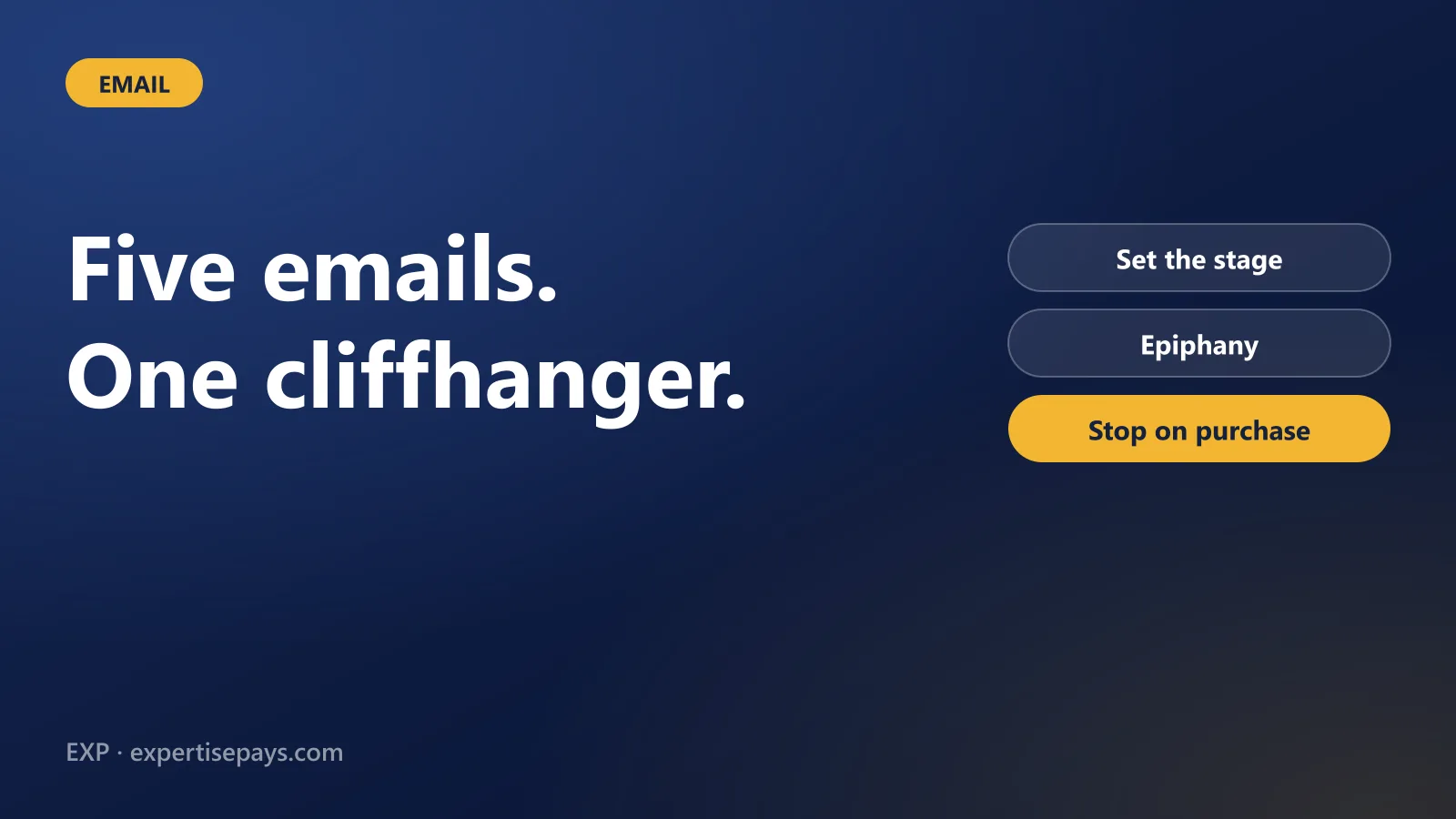
The Pickwick Papers nearly died after three instalments. One cliffhanger character made it a bestseller. The same structure runs a five-email welcome sequence.
March 1836, London.
A 24-year-old writer with no novel to his name agrees to write words to go with somebody else's drawings.
The publisher prints 1,000 copies of the first monthly instalment.
The first three instalments sell about 400 copies in total.
The illustrator dies. The publisher considers pulling the plug.
Then, in the fourth number, the writer introduces a Cockney bootblack called Sam Weller.
By the time the serial finished in November 1837, it was selling around 40,000 copies a number.
The writer was Charles Dickens. The book was The Pickwick Papers.
(Four hundred to forty thousand. If your welcome emails did that, you'd frame the dashboard.)
▋Why a monthly instalment beats a finished book
Dickens didn't write Pickwick as a book and chop it up.
He wrote it one number at a time, and every number had to do one thing.
Make you want the next one.
Each instalment ended with a hook. Each new one opened by paying it off, then setting another.
Readers queued for the next part. They talked about it in between.
The story became a thing that happened to the whole city together, one month at a time.
Russell Brunson borrowed that exact engine for email and called it the Soap Opera Sequence.
▋The five emails
Brunson's version is five emails sent on five consecutive days after someone joins your list.
Each one is an episode. Each one ends on a cliffhanger.
Email 1: set the stage
Thank them, tell them what's coming, and open a loop.
"Tomorrow I'll tell you about the day I nearly quit."
Email 2: high drama, backstory, the wall
Start in the middle of the worst moment.
Then rewind to how you got there.
End at the wall: the point where the old way stopped working.
Email 3: the epiphany
The moment you saw it differently.
This is where your method is born, told as a realisation, not a feature list.
Email 4: the hidden benefits
What changed once you applied it.
The things you didn't expect, the results that surprised you.
Email 5: urgency and the call to action
Now the offer, with a real reason to act now.
Not fake scarcity. A deadline, a bonus, a price that changes.
Five days. One story. One ask at the end.
▋What this fixes for course creators
Most welcome sequences are a receipt and a coupon.
"Here's your download. Here's 10% off. Bye."
That's not a story. That's a vending machine.
The Soap Opera Sequence does something different.
It makes the reader open email two because of email one.
By email five, they've spent four days inside your way of seeing the problem.
The offer doesn't feel like a pitch. It feels like the next instalment.
▋Sam Weller is your epiphany
Here's the part people miss about Pickwick.
The sales didn't jump because Dickens wrote harder.
They jumped because he introduced a character readers could love and follow.
Your email sequence has the same requirement.
Somewhere in those five emails, the reader needs someone to root for.
Usually that's you, at the moment you figured it out.
If your sequence has no Sam Weller, it's three instalments of 400 copies.
▋Making it run without you
The reason most people never build this is practical.
Five emails, a day apart, triggered by a form, stopped the moment someone buys.
Doable with a spreadsheet and a lot of remembering. Not doable at scale.
This is exactly what the email sequences in EXP are for.
A sequence starts when someone submits a lead form or gets a tag.
Each email has its own delay, so day one through day five is five rows, not five reminders.
And there's one rule we built in on purpose: if they buy, the sequence stops.
Nobody should get email five's hard sell the morning after they already purchased.
(Dickens, to be fair, kept selling instalments to people who'd already bought. Different era.)
▋Our take
We see a lot of lists with thousands of names and a welcome sequence that's one email long.
The names aren't the asset. The relationship is.
Five emails that tell a true story build more trust than fifty broadcasts.
So write your five instalments once.
Make email one promise something email two delivers.
Give them a character to follow.
Then let the sequence run, and let it stop itself when the job is done.
Dickens never finished a number without a reason to buy the next one.
Your reader shouldn't finish an email without one either.
Here's to your fourth instalment, the one where things turn.
(Our own welcome sequence took longer to write than this article. We're not proud of that.)
💡 Build your five emails and let them run. See the email sequence docs or start a free 7-day trial.
Sources: Dan Piepenbring, "The Sam Weller Bump", The Paris Review, April 14, 2015; "The Posthumous Papers of the Pickwick Club", University of Otago heritage catalogue (first number print run 1,000; about 40,000 by November 1837); "The Pickwick Papers", Wikipedia; Russell Brunson, DotCom Secrets (2015), "The Soap Opera Sequence".